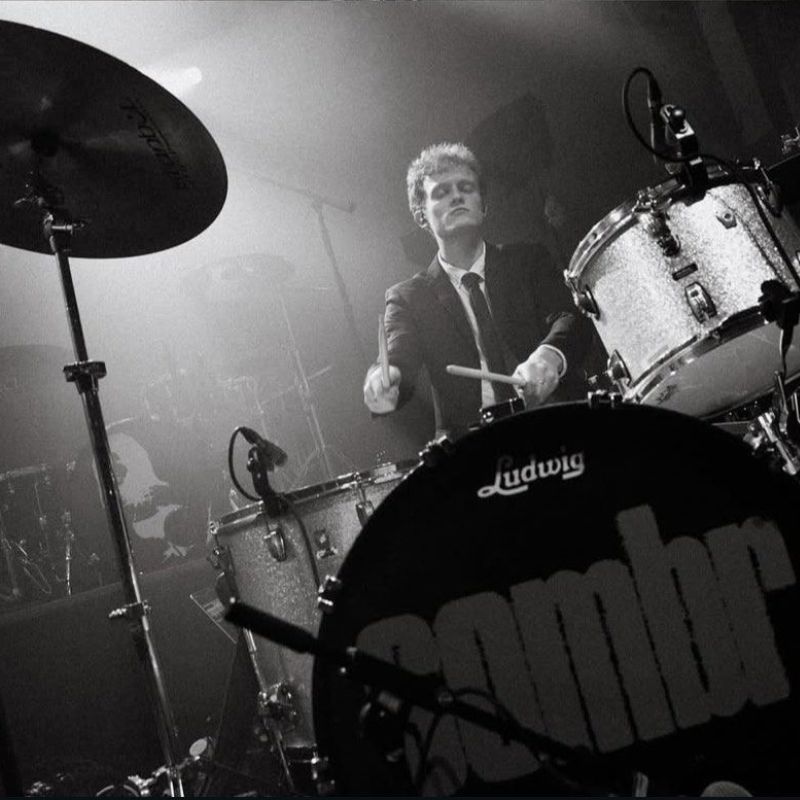
When Mitch Prewitt called in from Madrid, he sounded exactly like you’d expect someone on a months-long international tour to sound – a little tired.
The day before, he had been in Milan. A few days later, he’d be headed to the BRIT Awards with Sombr, the rapidly rising artist whose band he’s spent the last year touring with. Just weeks earlier, he’d performed at the Grammy Awards, but less than a year ago, he was still a student at NYU.
“It was just totally surreal,” Mitch said.
For anyone following Sombr’s rise, the last year has felt fast. For Mitch, it has felt even faster.
“When I left school, I never imagined that not even a year later I would be performing at the Grammy Awards.”
The performance itself was unforgettable. So was everything surrounding it.
One minute he was preparing for one of the biggest performances of his life. The next, he was looking around the room and realizing he was surrounded by people he’d spent years listening to, studying, and admiring. “I got up there and looked behind me and Jamie Foxx was behind me,” said Mitch. Backstage, Sombr’s room was next to Bruno Mars’ band.
Throughout Grammy week, Mitch found himself running into producers, artists, and musicians he’d idolized only a few years earlier. “It was just like everywhere we went, I was just running into heroes of mine.”
For a drummer from Birmingham, Alabama, it was the kind of week that doesn’t feel entirely real.
Then again, there have been a lot of those lately.
The Kid Who Didn’t Want Camp to End
Long before the Grammys, television appearances, and European tours, there was a summer camp when he was 11 years old.
“I think the first one I ever did was the summer camp.”
It was a Mason Music Rock Band League camp led by longtime instructor John-Mark Dorough. The format was simple: put a group of young musicians together, teach them songs, rehearse all week, and finish with a performance.
The performance came and went, then everybody went home. Mitch remembers being genuinely upset: “When I was done with it, I was so sad. My parents were concerned,” he laughed telling the story. “It was exactly what I wanted to do all the time.”
Then came the realization that would quietly shape the next decade of his life.
“That’s when I realized that all I wanted to do was be playing in a band.”
Learning Things You Can’t Learn Alone
Music had always been around throughout Mitch’s childhood. He recalls, “My dad got me my first drum set when I was 2.”
His father, drummer David Prewitt, filled their house with drums and instruments. They played together constantly while Mitch was growing up. But playing drums and playing in a band are different things.
Rock Band League became Mitch’s first real introduction to rehearsals, band dynamics, and the messy process of making music with other people.
Looking back, one lesson stands out most: “I learned how to stay out of the way and serve the music.”
That idea has followed him everywhere.
As a kid, it meant learning that not every song needed the drummer to fill every available space. It meant listening to singers, guitar players, and bass players. It meant understanding that great bands are built on musicians supporting one another rather than competing with one another.
Years later, that mindset would prove just as valuable as any technical skill.
Why Rehearsals Matter
One of the more surprising parts of our conversation was how often Mitch returned to the subject of rehearsals.
Not performances, or tours, or celebrity encounters. Rehearsals.
“Another huge thing is just running a rehearsal.”
He talked about learning how bands communicate. How decisions get made. How leaders guide a group toward a performance. How to respect other people’s ideas while still moving the work forward.
“Just having someone who is the band leader and calling the shots and listening to them, you learn how to fall in line.”
That lesson became even more obvious when he arrived at NYU’s Clive Davis Institute of Recorded Music.
By that point, Mitch had already spent years in bands. Years watching rehearsals. Years learning how musicians work together. He discovered that those experiences weren’t nearly as common as he had assumed, even among talented musicians. “You learn leadership skills just from watching.”
It’s not the sort of lesson that shows up on a transcript. But it sticks.
Beyond the Drum Kit
These days, Mitch is known primarily as a drummer.
Ask him what excites him most, though, and the conversation quickly expands. Producing. Engineering. Recording. Songwriting.
“I play pretty much everything that you use your hands on.”
At NYU, he spent countless hours in studios learning microphones, recording chains, signal flow, and production techniques. While other students were heading home, he was often booking extra studio time and experimenting.
“What I love to do is producing music.” The deeper he got into music, the more interested he became in understanding every part of how records are made, not just how they’re played.
The Smell of Mason Music
At one point in the conversation, Mitch mentioned something unexpected: the smell of the old Cahaba Heights location.
“I still remember the smell of the Cahaba Heights Mason Music so vividly.” He paused. “I don’t even know what it is.” Then he laughed, reassuringly, “It’s a good smell.”
Memory works like that sometimes.
Years later, after Grammy performances and international tours, the details that remain aren’t always the ones you’d expect. Sometimes it’s a room or a week-long camp you don’t want to end.
And sometimes it’s the realization that you’ve already found the thing you want to spend the rest of your life doing.
“It was exactly what I wanted to do all the time,” Mitch recounted.
As it turns out, he found a way to keep doing it just that.